Restoring Education in Autistic Children's Healthy Lives
Services
What We Do At Reach
We offer a variety of services to support your child’s autism.
Autism Therapy Through Reading Picture Books

Autism therapy that integrates picture book reading offers a gentle yet powerful approach to supporting communication, emotional development, and social understanding in children on the autism spectrum. These sessions use visually rich, narrative-driven books to create a structured and engaging environment where children can explore language, emotions, and interpersonal cues at their own pace.
Read More
🌟 Key Benefits:
Visual Support for Language: Picture books provide concrete visual cues that help children associate words with images, making abstract language more accessible.
Emotional Recognition: Stories often depict characters experiencing a range of emotions, allowing therapists to guide children in identifying and discussing feelings.
Social Skill Building: Through narratives, children learn about relationships, empathy, and problem-solving in social contexts.
Routine and Predictability: The structured format of reading sessions offers comfort and consistency, which is especially beneficial for children who thrive on routine.
Interactive Engagement: Therapists can use questions, role-play, and visual aids to encourage participation and reinforce comprehension.
🧠 Therapeutic Techniques:
Joint Attention Practice: Encouraging shared focus on the book helps develop foundational social communication skills.
Modeling and Repetition: Therapists model language and behavior repeatedly to reinforce learning.
Customized Book Selection: Books are chosen based on the child’s interests and developmental level to maximize engagement and relevance.
📖 Example Activities:
Acting out scenes from the book to practice expressive language
Pointing to and naming emotions shown in illustrations
Predicting what might happen next to build inferencing skills
Using visual schedules that incorporate book reading as part of the therapy routine
Autism Therapy Through Puzzles - Unlocking Minds Piece by Piece
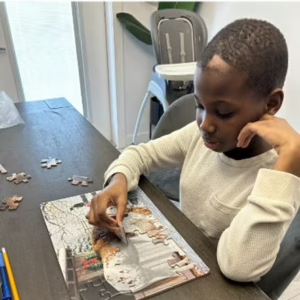
Puzzles are more than just a pastime—they’re a powerful therapeutic tool in autism support. Designed to stimulate cognitive development, enhance fine motor skills, and encourage focus, puzzles offer a structured yet playful way for individuals with autism to grow and connect.
Read More
In therapy sessions, puzzles help foster:
Cognitive engagement: Sorting shapes, matching patterns, and visual problem-solving build executive functioning and processing skills.
Language and communication: Therapists may use puzzles as conversational prompts, encouraging verbal interaction and descriptive language.
Sensory regulation: Tactile puzzle pieces provide sensory input that can be calming or stimulating, depending on individual needs.
Social connection: Cooperative puzzle play supports turn-taking, joint attention, and shared goals—skills crucial for interpersonal relationships.
Confidence and independence: Completing a puzzle delivers a sense of achievement and reinforces perseverance.
With carefully chosen puzzle types—from jigsaws to spatial manipulatives to digital formats—therapists tailor activities to each individual’s strengths and challenges. Whether used one-on-one or in group therapy, puzzles serve as bridges to deeper understanding and meaningful growth.
Autism Therapy Through Stacking Blocks
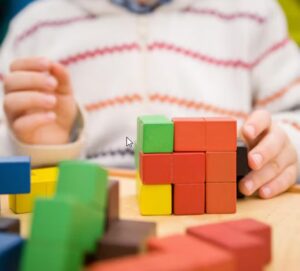
Using stacking blocks in autism therapy is a hands-on, play-based approach that supports a wide range of developmental goals—from fine motor coordination to cognitive flexibility and social interaction. This simple yet versatile activity becomes a powerful therapeutic tool when guided by a trained professional, helping children on the autism spectrum build foundational skills in a fun and structured way.
Read More
🌟 Key Benefits:
Fine Motor Development: Stacking blocks strengthens hand-eye coordination, grip control, and precision.
Visual-Spatial Skills: Children learn to judge size, shape, and spatial relationships as they build structures.
Turn-Taking and Cooperation: Block play can be used to practice sharing, waiting, and collaborative building with peers or therapists.
Language and Communication: Therapists use block play to introduce descriptive language, action words, and sequencing vocabulary (e.g., “first,” “next,” “on top”).
Problem-Solving and Flexibility: Children are encouraged to experiment, adapt, and try new strategies when blocks fall or designs change.
Therapeutic Techniques:
Modeling and Prompting: Therapists demonstrate stacking and guide children with verbal or physical prompts.
Structured Play Routines: Predictable sequences help reduce anxiety and increase engagement.
Sensory Regulation: The tactile and visual nature of blocks can be calming or stimulating, depending on the child’s sensory profile.
Goal-Oriented Challenges: Tasks like “build a tower with five blocks” or “match the color pattern” promote focus and achievement